Anti-Roll Bar Linkage Ball Joint on Your MOT: What It Means
This one produces some of the longest lines on any MOT certificate, and some of the most puzzled faces in our waiting rooms. The wording comes in two strengths:
Anti-roll bar linkage ball joint has slight play (advisory)
Anti-roll bar linkage ball joint excessively worn (5.3.4 (a) (i))
In short: the anti-roll bar linkage, usually called a drop link, is the short rod that connects the anti-roll bar to the suspension, with a small ball joint at each end. “Slight play” means that joint has started to wear: it is an advisory and the car passes. “Excessively worn” means it is loose enough to fail the MOT as a Major defect. The usual symptom is a knock or rattle over speed bumps.
One quick translation before we go any further: nearside means the passenger side of the car, the side nearest the kerb. Offside means the driver’s side. So a defect recorded as nearside front is on the front passenger side, and offside rear is behind the driver. Front and rear, inner and outer, upper and lower simply pin down exactly which component the tester was looking at.
What Is an Anti-Roll Bar Linkage?
The anti-roll bar is a sprung steel bar connecting the left and right sides of your suspension. Its job is to stop the body leaning heavily in corners. The linkages, better known in the trade as drop links, are the short rods with a small ball joint at each end that tie the bar to each side’s suspension strut. They are hard-working little parts: every bump, every corner, every pothole works those ball joints, in all weathers, a few inches from the road.
The Sound You Have Probably Been Hearing
A worn drop link is one of the great automotive rattles. The classic symptoms:
- A knock or rattle from one corner over speed bumps and rough surfaces.
- A clonk when you turn into your drive or cross a pothole.
- A slightly looser, clumsier feel in quick direction changes.
Because the joint only knocks under certain loads, it can be maddening to pin down from the driver’s seat. On the ramp, with a lever on the joint, it takes seconds: the play is felt and seen directly, which is exactly what the MOT tester does.
Advisory or Failure: What the Two Wordings Mean
Slight play is the advisory: the joint is starting to wear, it is being noted, and the car passes. Excessively worn, under 5.3.4 (a) (i), is a Major defect and a failure: at that point the joint is loose enough to affect how the suspension controls the car. The same defect code covers the whole suspension joint and bush family, which is why it appears on so many certificates: our guide to the suspension arm bush MOT failure covers its most common sibling.
There is a third, rarer level: a joint so worn that it is likely to come apart is recorded under 5.3.4 (a) (ii) as Dangerous, and the car should not be driven until it is fixed. The same rule covers the link’s pins and bushes as well as its ball joints, which is why some certificates say “anti-roll bar linkage pin or bush worn” instead.
The rubber boot over each ball joint has its own lines under 5.3.4 (b): a dust cover that is severely deteriorated is a Minor defect, and one that is missing or no longer keeps the dirt out is a Major failure. A split boot lets in water and grit, so it is often the start of the play described above.

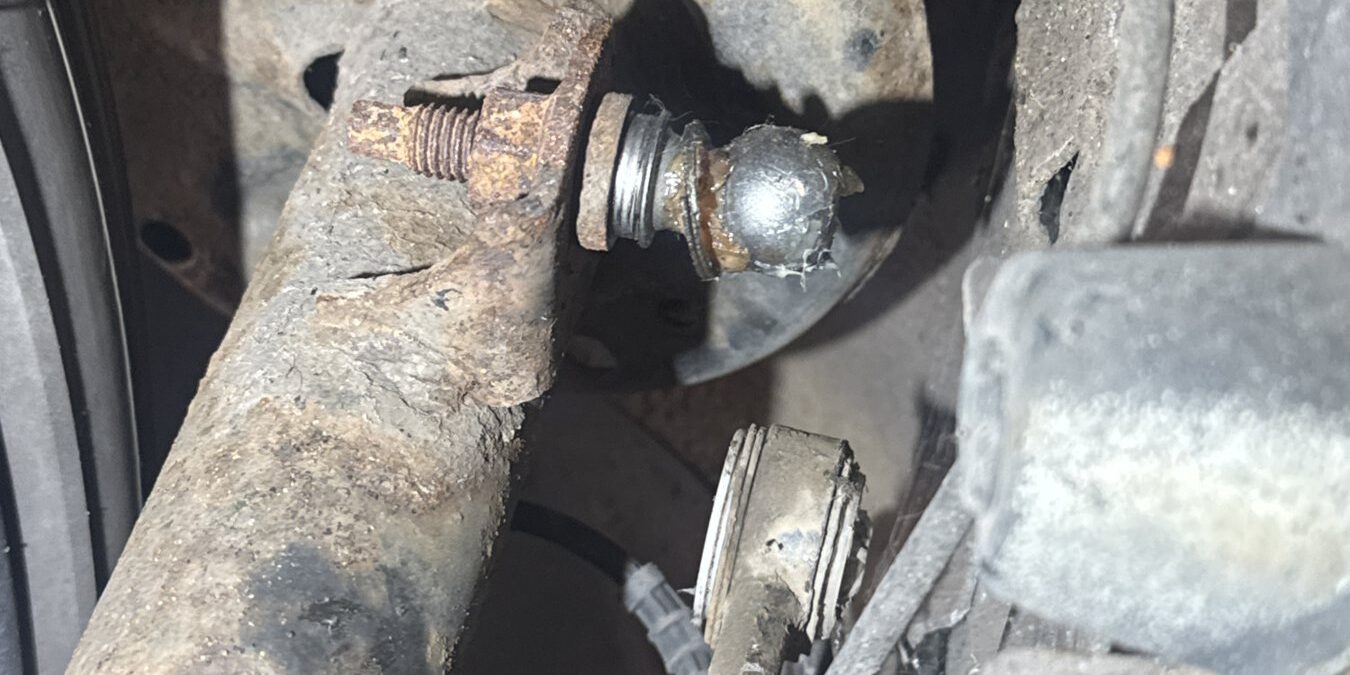
Found by our technician at Carlton: the ball joint has pulled right out of the drop link, so the anti-roll bar is no longer connected on this side. This is well past an advisory: a joint that has come apart is a Dangerous defect.
How the Tester Checks It
With the car on the ramp, the tester levers the suspension or uses wheel play detectors (plates that shake each wheel) while watching each joint. A healthy drop link joint shows no free movement; a worn one visibly knocks back and forth. Rubber bushes are allowed some flex, so the tester only rejects those when the rubber has seriously deteriorated.
Most cars have drop links at the front, and many have a second pair on the rear anti-roll bar, so the certificate names the corner: nearside front, offside rear and so on.
Is It Serious?
A drop link with slight play will not throw the car off the road: it is a genuine advisory, and a common one. But the wear only accelerates, the rattle only gets louder, and a badly worn link blunts the anti-roll bar entirely, which you feel as extra body roll and vaguer handling. It can also mask or accompany wear in the joints and bushes around it, so the honest move is a proper look rather than a year of turning the radio up. Our guide to suspension warning signs puts the noises in context.
How It’s Repaired
Drop links are replaced rather than repaired, and on most cars they are among the most reasonable suspension jobs there is. While the corner is up we check the anti-roll bar bushes and the joints around the link, because they wear as a family, and we road test to confirm the noise has actually gone: it is not unheard of for a speed-bump rattle to have two causes at once.
Book a Suspension Check
If your MOT sheet mentions an anti-roll bar linkage, or your car has developed the speed-bump rattle, call into any of our 12 branches across Nottinghamshire. Our free vehicle health check will identify the joint, show you the play, and price the fix in plain English before anything is agreed. You can also book an MOT online today.
Frequently asked questions
What is the anti-roll bar linkage on my MOT certificate?
It is the drop link: the short rod with a ball joint at each end connecting the anti-roll bar to each side of the suspension. Slight play in the joint is an advisory; excessive wear under 5.3.4 (a) (i) is a Major defect and fails the test.
Can I drive with a worn drop link?
With slight play, yes: the car has passed and you have time to plan. With an excessively worn joint the car has failed its MOT, and the loose joint is blunting the anti-roll bar and knocking against its mounting, so have it replaced promptly.
Is a knocking noise over speed bumps always a drop link?
It is the most common cause, but not the only one: anti-roll bar bushes, suspension arm bushes, top mounts and even loose exhaust hangers can all knock. The way to be sure is a lever and a trained hand on the ramp, not guesswork.
What do nearside and offside mean on an MOT?
Nearside is the passenger side of the vehicle, the side closest to the kerb when you are driving in the UK. Offside is the driver’s side. The MOT certificate uses these words so there is no confusion about which corner of the car the defect relates to.
Is a broken anti-roll bar an MOT failure?
Yes. The bar itself is checked under 5.3.3: one that is excessively damaged or corroded is a Major defect, and one that is fractured is Dangerous. A drop link that has snapped or come apart at the joint is treated as Dangerous too.
Is a drop link the same as an anti-roll bar linkage?
Yes, they are the same part. “Anti-roll bar linkage” is the MOT manual’s name; drop link, stabiliser link and anti-roll bar link are what garages and parts suppliers call it.
How much does it cost to fix an anti-roll bar linkage?
It depends on the underlying cause and the vehicle, which is why we always inspect first. Once we can see exactly what is needed we will explain it in plain English and confirm the price with you before any work starts.