TPMS MOT Failure: Why a Tyre Pressure Warning Light Can Fail Your Car
That amber tyre pressure warning light is one of the easiest lights on the dashboard to ignore. The car still drives fine, so it can wait. Then the MOT comes around. A TPMS MOT failure is one of the most avoidable fails we see across our Nottinghamshire workshops, and it catches drivers out because the rule is stricter than most people realise.
TPMS stands for tyre pressure monitoring system. A small battery-powered sensor inside each wheel measures the pressure and warns you on the dash when a tyre is going down. It has been fitted to new cars by law since 2012, and it has been checked as part of the MOT test since 2015.
The Exact MOT Failure Wording
This is the defect the tester records, word for word, from the MOT inspection manual:
“Tyre pressure monitoring system malfunctioning or obviously not working”
Defect 5.2.3 (h), MOT inspection manual, section 5.2.3 Tyres. Category: Major.
A Major defect means an automatic fail. The rule applies to passenger cars first used on or after 1 January 2012. If your car is older than that, TPMS is not part of its MOT, even if sensors are fitted.
The Light On Its Own Is Not Always a Fail
What matters is what the light is telling the tester:
- A light that comes on and stays on steadily is usually a low pressure warning. That is the system doing its job, not the system failing.
- A light that flashes for a minute or so after start-up and then stays on is reporting a system malfunction. That is the Major defect above.
- Some cars remove all doubt and spell it out with a message on the dash.
If you are not sure which light we mean, it is this one: an amber horseshoe with an exclamation mark, which is a tyre seen head-on.

The TPMS warning light: an amber horseshoe with an exclamation mark.
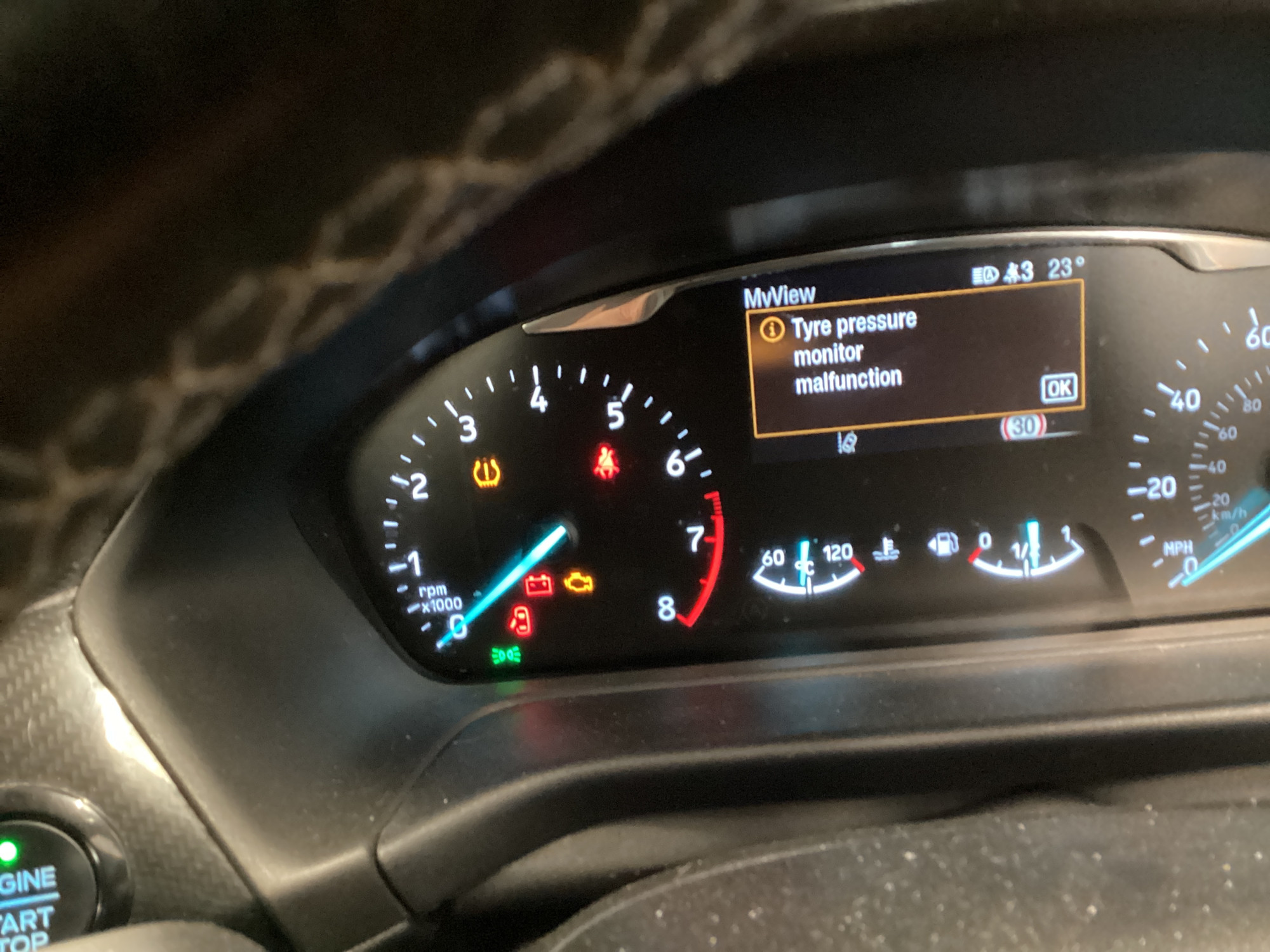
The exact warning that fails an MOT: a tyre pressure monitor malfunction message on a Ford in one of our workshops.
This Ford came into one of our branches showing exactly that: the tyre pressure monitor malfunction message spelled out on the dash. No amount of topping up the tyres will put that right: the system itself has a fault.
If the tester cannot be sure whether the light means a malfunction or just a low tyre, they should record an advisory rather than a fail. But turning up to an MOT with the light on is a gamble, and it is an easy one to take off the table beforehand.
What We Find When We Check
This is why we now offer a free TPMS check at all of our branches. It only takes a few minutes: we read each wheel with a dedicated TPMS tool and see the sensor ID, the pressure it is reporting, its temperature and its battery state. No guesswork, no stripping wheels down to have a look.

Reading all four sensors at once on a BMW 1 Series: both right-hand tyres were around 10 PSI down.
On this BMW 1 Series every sensor answered straight away, and the readings showed both right-hand tyres sitting around 10 PSI lower than the left. Nothing wrong with the system at all: it just needed the pressures correcting.

A healthy sensor doing its job on a Jaguar XF: the tyre really was down to 18.8 PSI.
The same story on this Jaguar XF, but more serious. The sensor tested healthy, battery OK, and it was warning for a very good reason: the tyre was down to 18.8 PSI, a long way below where it should have been.

A dead sensor removed from a wheel, caked in dried puncture sealant.
And then there are the ones that really have died. This sensor came out of a wheel caked in dried puncture sealant. Sealant is great for getting you home after a puncture, but it coats everything inside the tyre, including the sensor, and this one was never going to report a pressure again.
TPMS in 55 seconds: the warning light, why it comes on, and how the check finds the problem.
Why TPMS Sensors Fail
- Every sensor has a sealed battery with a typical life of 5 to 10 years. It cannot be replaced on its own, so when the battery dies, the sensor is replaced. Cars from 2012 to 2018 are right in that window now.
- The metal valve stems corrode, especially where winter road salt gets to work.
- Tyre puncture sealant can clog the sensor.
- Kerb strikes and careless tyre changes can damage them.
One more thing worth knowing: all four sensors went into the car on the same day. When one battery dies of old age, the others are usually not far behind, so it is worth having the rest checked at the same time.
How We Replace a Faulty TPMS Sensor
- We scan all four wheels first, so we know exactly which sensor has failed and why. You only replace what actually needs replacing.
- The tyre comes off the bead and the old sensor comes out.
- We fit a quality programmable sensor, programmed to your exact make, model and year. The car treats it just like the original.
- A new valve service kit goes in at the same time, since a corroded valve will only cause the next problem.
- The car then relearns the new sensor. On most models this happens automatically within a short drive, and we confirm all four corners are reporting before the car leaves.
The cheapest time to replace a tired sensor is when you are having tyres fitted anyway, because the tyre is already off the wheel. It is one of the questions we ask during every tyre change for exactly that reason.
Teslas Are Slightly Different
Tesla drivers, one extra wrinkle. Earlier Teslas use the same 433MHz radio sensors as everything else. But from the 2021 refresh onwards, including newer Model 3 and Model Y, Tesla switched to Bluetooth Low Energy sensors instead. The two types are not interchangeable: a standard sensor will never pair with a Bluetooth car, no matter how it is programmed.
The fix is simply fitting the correct Bluetooth sensor for the car, and Teslas then make life easy: the car finds the new sensor by itself within a couple of miles of driving. We can supply and fit both types, so a TPMS fault on a Tesla is no more drama than on anything else.
Book a Free TPMS Check
If your tyre pressure light is on, or your MOT is coming up and you want the gamble taken off the table, book a free TPMS check at any of our branches across Nottinghamshire. We will tell you whether the system is healthy, whether a tyre simply needs air, or whether a sensor is on its way out, before any work is done and before the MOT tester ever sees the light.
While you are at it, you can book an MOT online in a couple of minutes too. You can also find out more about our full range of tyre services on the website, or call your local branch and we will get you booked in.
Frequently asked questions
Will my car fail the MOT if the tyre pressure light is on?
If the light is indicating a system malfunction, for example it flashes after start-up and then stays on, or the dash shows a fault message, then yes: it is a Major defect and an automatic fail. If it is a steady low pressure warning the tester should not fail it for that alone, but it is far safer to have it checked and put right before the test.
My car was registered before 2012. Does this rule apply?
No. The TPMS check only applies to passenger cars first used on or after 1 January 2012. On older cars the system is not inspected, even if sensors are fitted.
How long do TPMS sensor batteries last?
Typically 5 to 10 years. The battery is sealed inside the sensor and cannot be replaced on its own, so when it runs out the sensor is replaced. Many cars from 2012 to 2018 are reaching that point now.
Do all four sensors need replacing at once?
No. We scan each wheel individually and only replace what has actually failed. That said, all four sensors are the same age, so when one battery dies it is worth having the others checked at the same visit.
Can you check my TPMS before the MOT?
Yes, and it is free. Our TPMS check reads every sensor in a few minutes and tells you whether the system is healthy, a tyre just needs air, or a sensor is failing, so there are no surprises on test day.