Tesla Brake Disc Corrosion: The Fault We’re Seeing Most on Teslas in Nottinghamshire
If you own a Tesla and you’ve been told your discs are rusty, pitted or need replacing, you’re in very good company. Tesla brake disc corrosion has quickly become one of the most common faults we deal with at Lindleys Autocentres, and it’s only getting more common as the first big wave of UK cars comes out of warranty.
We now see hundreds of Teslas a month across our Nottinghamshire workshops for servicing, MOTs, tyres and repairs, and corroded rear discs come up again and again. It’s the same story on Tesla owner forums and Reddit threads: orange rust after the car has stood for a few days, heavy pitting on the rear discs, a pulsation through the pedal, and an MOT advisory or failure that comes as a nasty surprise.
Here’s what’s actually going on, what it looks like on the ramp, and what can be done about it.
Why We’re Seeing So Many Teslas
Two things have changed at once.
First, the early UK Teslas are now coming out of their warranty periods, so owners are looking for a trusted independent garage rather than automatically heading back to the manufacturer. Second, we look after a large number of Teslas on behalf of lease and fleet companies, which means cars come to us throughout their contract life — often several years and many thousands of miles before a private owner would notice anything.
That combination gives us an unusually early view of the faults that are becoming common across the model range. When the same issue keeps appearing on lease cars at three or four years old, we know exactly what to look for when a private owner’s car arrives with the same age and mileage. Brake disc corrosion is comfortably top of that list.
What Is Tesla Brake Disc Corrosion?
Every brake disc rusts a little. Leave any car outside overnight in the rain and you’ll see a light orange film on the discs the next morning, which is scrubbed off within a few hundred metres of driving.
The difference with an electric car is that the friction brakes barely get used. Teslas rely heavily on regenerative braking, where the motor slows the car and recovers energy back into the battery. In everyday driving — especially gentle commuting and town use — the pads may only lightly touch the discs.
That means:
- The surface rust is never properly cleaned off by the pads.
- Moisture, road salt and grit sit on the disc face for weeks at a time.
- Corrosion eats into the metal rather than being polished away.
- The pitting spreads outwards from the edges and inwards across the braking surface.
Add a wet British winter and salted roads from November to March, and you have close to perfect conditions for Tesla brake disc corrosion.
Why the Rear Discs Suffer Worst
The rears do the least work. Regen braking plus the natural forward weight transfer under braking means the rear pads are doing very little on most journeys. The rear discs are also the ones sitting in the spray thrown up by the front wheels.
So while the front discs on a Tesla often look reasonable, the rears can be badly pitted well before the car has done big mileage. Age and standing time matter far more than the number on the odometer.
What Tesla Brake Disc Corrosion Looks Like
These are genuine examples photographed in our workshop.
Pitting Across the Friction Face
Look closely at the braking surface here and you can see the disc is no longer a smooth, even face. The metal is pitted and rough, with the pad only making proper contact across part of the surface. The lighter bands are where the pad has been working; the darker, rougher areas are corroded and effectively doing nothing.
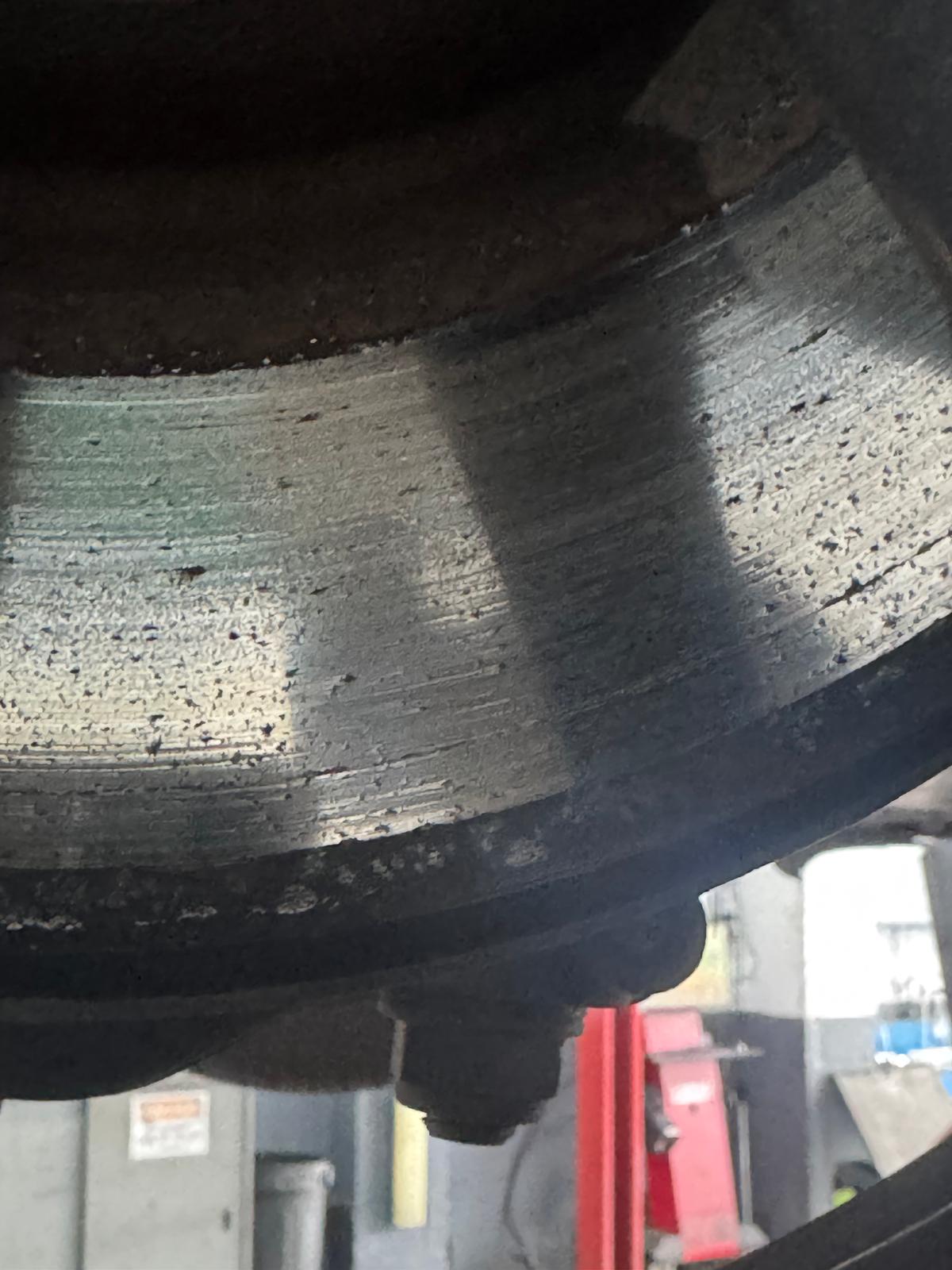
Heavy pitting across the friction face — the pad is only making full contact in places.
Corrosion at the Edges and Around the Hub
Corrosion almost always starts at the outer edge and around the centre of the disc, then works its way into the swept area. In this shot you can see the rust build-up around the hub and the ridge of corroded material sitting at the inner edge of the braking surface.
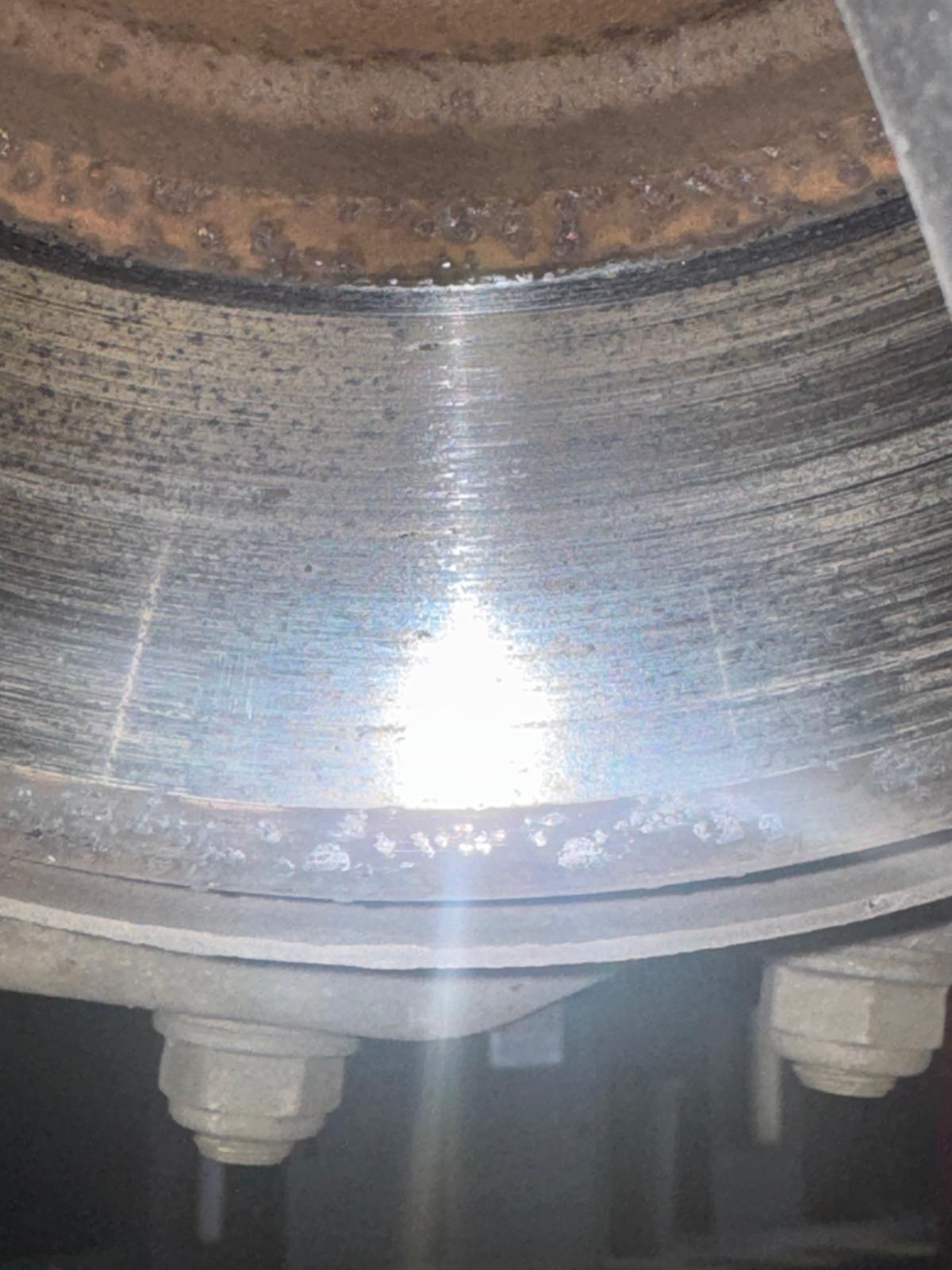
Rust building around the hub and disc edges before it spreads across the friction surface.
Measuring What’s Actually Left
Rust doesn’t just look bad — it removes metal. That’s why we don’t judge a disc by eye alone. Our technicians measure disc thickness with a digital micrometer and compare it against the manufacturer’s minimum figure, checking several points around the disc so that any pitting or uneven wear shows up.
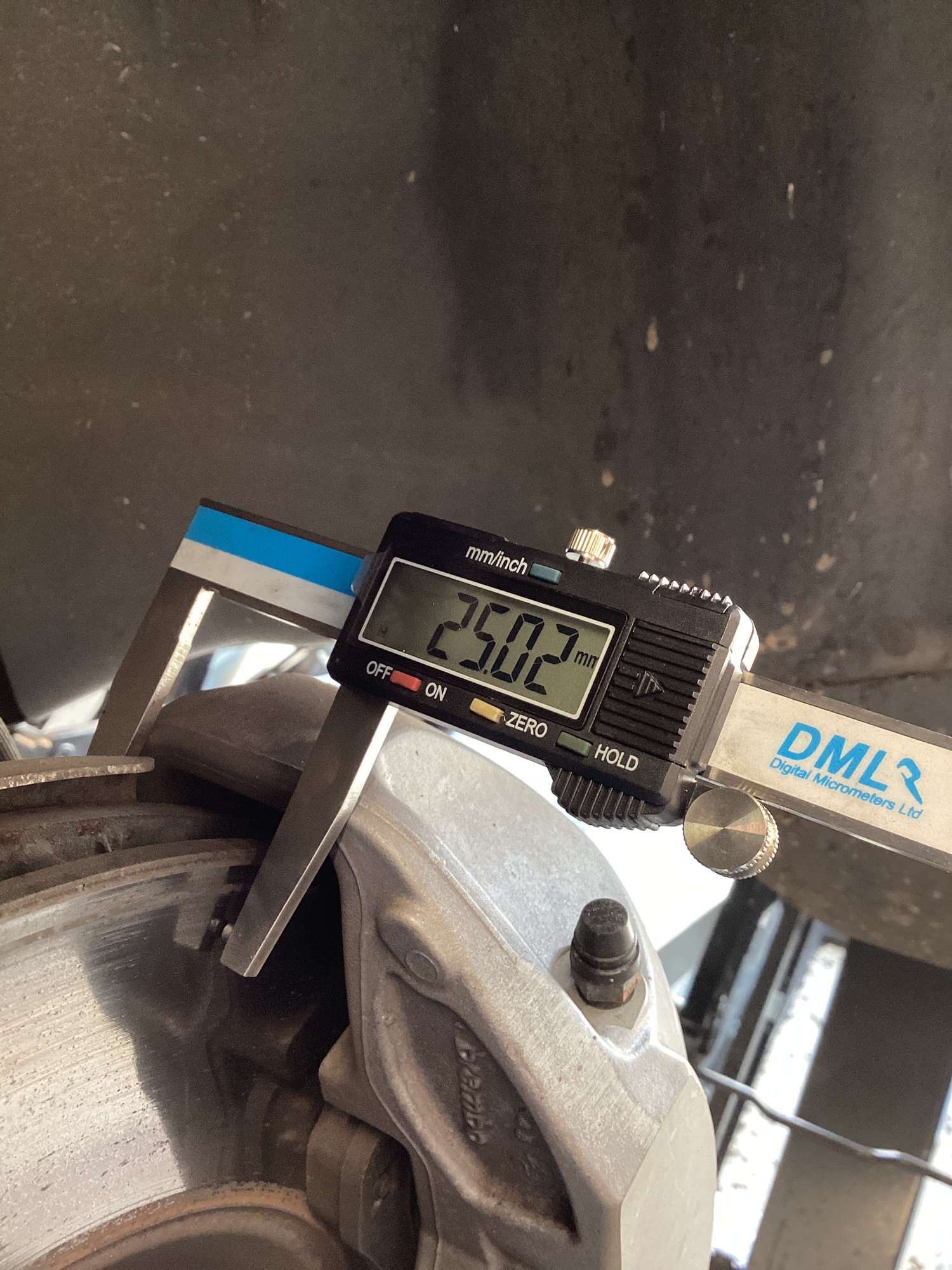
Measuring disc thickness with a digital micrometer rather than judging corrosion by eye.
Symptoms Tesla Owners Notice
The complaints we hear in reception are remarkably consistent, and they mirror what owners report online:
- Orange rust after the car has stood — particularly after a weekend on the drive or a spell of wet weather.
- A grinding or scraping noise for the first few stops, sometimes with the brakes feeling grabby.
- Pulsation through the pedal when you do brake firmly, caused by an uneven, corroded disc surface.
- An MOT advisory or failure for pitted, scored or worn discs.
- A handbrake or parking brake that binds after the car has been left standing.
If you’re getting vibration or noise, our guide on how to detect issues with your brakes is worth a read alongside this.
Will Corroded Discs Fail an MOT?
They can, yes. Light surface rust is normal and won’t cause a problem. The MOT tester is looking at whether the disc is worn, pitted or scored to the point that its condition or performance is affected — wording along the lines of a brake disc being “worn, pitted or scored, but not seriously weakened” as an advisory, moving to a failure where the disc is significantly and obviously worn or seriously weakened.
In practice, that means a Tesla can breeze through on emissions and lights, then trip up on a set of rear discs that have quietly rotted away while regen did all the stopping. It’s a good example of why the most common MOT failures aren’t always the things drivers expect.
Can You Still Drive With Corroded Tesla Brake Discs?
It depends entirely on how far it has gone.
Light surface rust that cleans off after a few firm stops is nothing to worry about. Deep pitting is different. Once the friction surface is broken up, the pad has less good metal to grip, braking performance in an emergency stop can be reduced, and the corrosion will keep spreading.
Remember that your Tesla will still stop very capably on regen in normal driving — which is exactly why a deteriorating friction brake can go unnoticed until the day you genuinely need it. If you have grinding, pulsation or a warning about brake performance, get it inspected promptly rather than waiting for the MOT.
How We Repair It
The honest answer is that badly corroded discs can’t be polished back to health. Once metal has been lost to pitting, the repair is replacement.
A typical job on a Tesla involves:
- Measuring disc thickness and inspecting the full friction surface on all four corners.
- Checking pad thickness and, importantly, whether the pads are moving freely in the carriers — seized sliders and sticking rear pads are common on cars that use regen most of the time.
- Replacing discs and pads as an axle set so braking stays even side to side.
- Cleaning and greasing the carriers and hub faces so the new discs sit true and don’t seize on.
- Retracting and resetting the electric parking brake correctly with diagnostic equipment, then bedding the new brakes in on a road test.
In milder cases where corrosion is caught early and the discs still measure well within tolerance, a service, a good clean-up of the caliper hardware and a change of driving habit can be enough to keep them going. That’s a call we make with the micrometer, not a guess.
How to Slow It Down
Tesla owners on Reddit and the owners’ forums have landed on the same advice we give in the workshop: use your friction brakes.
- Every week or two, on a clear, safe stretch of road, make a few firm braking applications from moderate speed to scrub the discs clean.
- Do the same after the car has been washed, or after it has stood for several days in wet weather.
- If your car has selectable regen or hold settings, mixing up how you drive occasionally helps.
- Avoid leaving the car parked for long periods with wet, salty discs where you can.
- Have the brakes properly inspected, cleaned and lubricated at every service — see our advice on maintaining your vehicle’s brakes for a longer life.
None of this reverses corrosion that’s already there, but it makes a real difference to how long a fresh set of discs lasts.
Tesla Servicing, MOTs, Tyres and Brakes in Nottinghamshire
We’ve become the go-to independent garage in Nottinghamshire for Tesla owners, with hundreds of Teslas coming through our workshops every month — private cars now out of warranty alongside a steady stream of lease and fleet vehicles — for servicing, MOT testing, tyres and repairs.
Our technicians are trained and equipped for EV work, and we’ll explain what we’ve found in plain English — with photos and measurements, not scare tactics. If you’re new to electric ownership, our guide to electric car servicing covers what does and doesn’t need doing.
If your Tesla’s discs look rusty, the brakes are pulsating, or you’ve picked up an MOT advisory, book it in with your nearest Lindleys Autocentres branch. You can arrange car servicing, book an MOT or order Tesla tyres online. We’ll measure the discs properly and tell you whether they need replacing now, or whether they’ll comfortably see out another year.
Frequently asked questions
Is brake disc corrosion normal on a Tesla?
A light film of surface rust is completely normal on any car after rain or a few days standing, and it usually cleans off within a few stops. What isn’t normal is deep pitting that stays on the disc, and that is far more common on Teslas because regenerative braking means the friction brakes are rarely used hard enough to keep the discs clean.
Why do Tesla rear discs corrode faster than the fronts?
The rear brakes do the least work. Regen braking plus forward weight transfer under braking means the rear pads barely touch the discs in normal driving, while the rear discs also sit in the spray thrown up by the front wheels. That combination of moisture, salt and no cleaning action lets corrosion take hold.
Can corroded Tesla brake discs be skimmed instead of replaced?
Rarely. Skimming removes metal from a disc that has already lost thickness to corrosion, and most modern discs simply don’t have enough material to spare. Once we’ve measured the discs against the manufacturer’s minimum thickness, replacement in axle sets is almost always the correct and safer repair.
Will rusty discs fail the MOT?
Light surface rust won’t. Discs that are pitted, scored or worn enough to affect braking performance will attract an advisory, and seriously worn or weakened discs are an outright failure. It’s one of the most common reasons we see otherwise healthy Teslas fail their MOT.
How can I stop my Tesla’s brake discs rusting?
Use the friction brakes regularly. Every week or two, on a clear and safe road, make a few firm stops from moderate speed to scrub the disc faces clean, and do the same after washing the car or after it’s stood in wet weather. Regular servicing that includes cleaning and lubricating the caliper hardware also helps a lot.