Brake Hose Has Slight Corrosion to Ferrule: MOT Advisory Explained
This one appears on a lot of certificates, usually with a corner of the car in front of it, and it sounds more alarming than it is. The wording looks like this:
Nearside rear brake hose has slight corrosion to ferrule (1.1.12 (f) (i))
In short: Slight corrosion to a brake hose ferrule is an advisory: the car passes. If the ferrule is excessively corroded it fails with a Major defect under 1.1.12 (f) (i), and if it is so corroded it is likely to fail, that is Dangerous under 1.1.12 (f) (ii).
One quick translation before we go any further: nearside means the passenger side of the car, the side nearest the kerb. Offside means the driver’s side. So a defect recorded as nearside front is on the front passenger side, and offside rear is behind the driver. Front and rear, inner and outer, upper and lower simply pin down exactly which component the tester was looking at.
What Is a Brake Hose Ferrule?
Most of your car’s brake lines are rigid steel pipes. At each wheel, where the brakes have to move with the suspension and steering, the pipe hands over to a flexible rubber hose. The ferrule is the metal sleeve crimped around the end of that hose, gripping the rubber onto its metal fitting. It sits right behind the wheel, in the spray of salty road water, so it corrodes like everything else down there.
Advisory, Major or Dangerous
The reference number on the advisory is the same one used for a fail, which confuses people. The manual’s wording for the defect itself is brake hose ferrules excessively corroded (1.1.12 (f) (i)), a Major defect. When the tester sees surface corrosion that is not at that point yet, they record it as an advisory under the same reference, using the word slight. Corrosion so bad that the ferrule is likely to fail moves up to Dangerous (1.1.12 (f) (ii)).
The same section covers the rubber itself: a hose that is slightly chafed or twisted is a Minor defect, one that is excessively damaged, perished, chafed, twisted or stretched is Major, and so is a hose that bulges under pressure or is porous. A hydraulic hose or connection that is leaking is Dangerous.
Why It Is Worth Keeping an Eye On
A brake hose holds the pressure that stops the car. Corrosion at the ferrule weakens the crimp that keeps the hose on its fitting, and hoses age from the inside too: a hose can break down internally and act like a one-way valve, holding the brake on after you lift off the pedal. If a car pulls to one side or a wheel runs hot after a drive, a tired hose is one of the suspects, alongside a sticking caliper. Our post on why brakes lock up and do not release goes into that in more detail.
Brake hoses are normally replaced in pairs across an axle, and the brakes are bled afterwards. Because the steel pipe meets the hose at the same union, it is also the moment to check the pipe end. If your certificate mentioned corroded pipes as well, see our earlier post on brake pipe corroded advisories.
Booked In Soon?
If a ferrule advisory has been sitting on your last two certificates, it is time to look. Our free brake check covers hoses, pipes, pads and discs. Any of our 12 branches across Nottinghamshire can take a look, and with over 20,000 MOT tests a year behind us there is not much we have not seen. We will show you what we found, explain it in plain English and confirm the price before any work starts. Book an MOT online when you are ready.
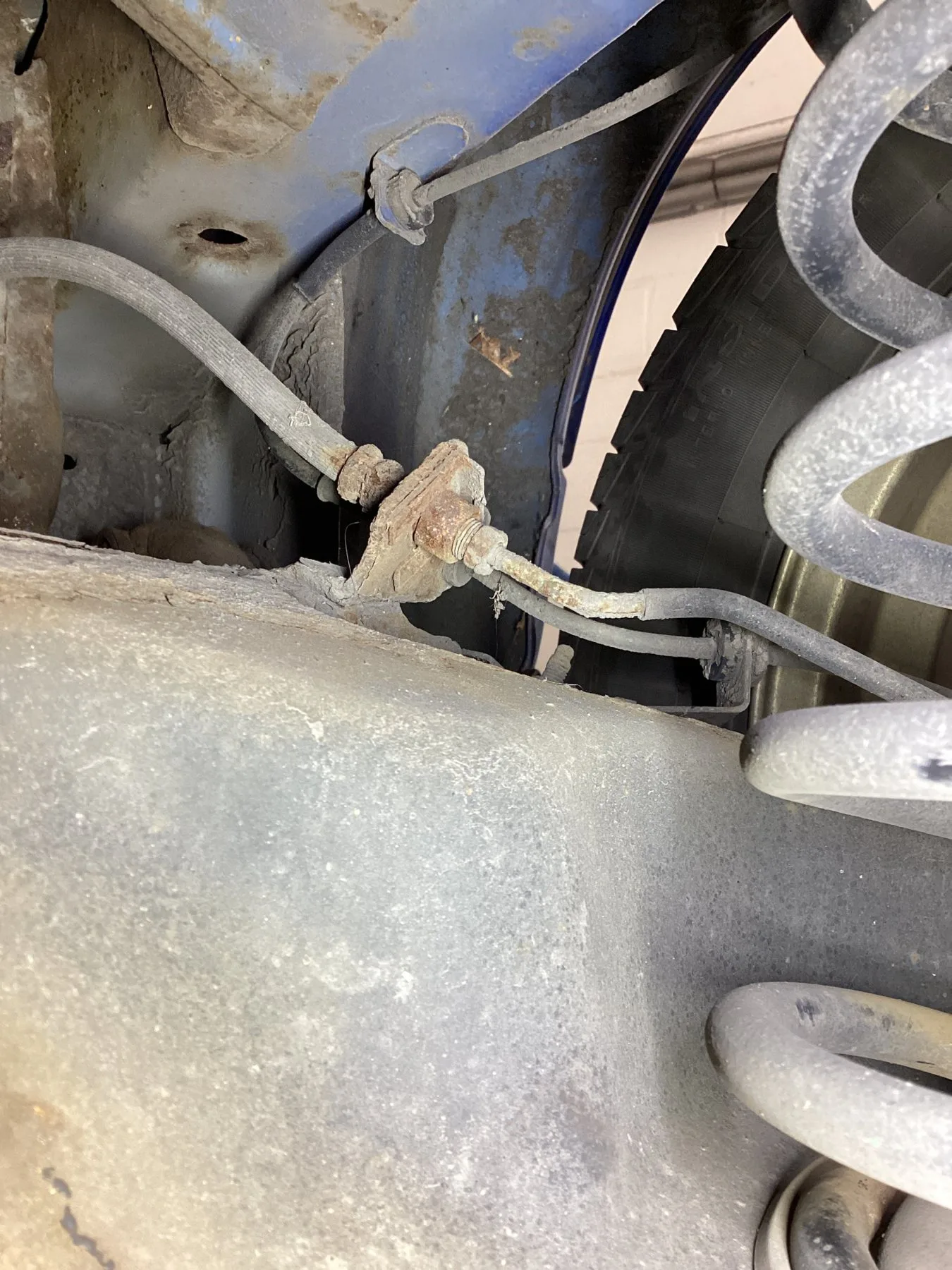
Corrosion at the union where a steel brake pipe meets the flexible hose bracket: the area a tester checks for ferrule corrosion.
Frequently asked questions
Is brake hose corrosion to ferrule an MOT fail?
Slight corrosion is an advisory and the car passes. Excessive corrosion to the ferrule is a Major defect and fails under 1.1.12 (f) (i). Corrosion so severe that the ferrule is likely to fail is Dangerous under 1.1.12 (f) (ii).
What is a ferrule on a brake hose?
It is the metal sleeve crimped around the end of the flexible rubber brake hose, holding the hose onto its metal end fitting. It sits behind the wheel, exposed to road salt and water.
Can a bad brake hose cause a caliper to stick?
Yes. A hose that has broken down internally can let fluid through to the caliper but slow its return, so the brake stays partly on. The symptoms are similar to a seized caliper: pulling to one side, a hot wheel, or a burning smell after a drive.
What do nearside and offside mean on an MOT?
Nearside is the passenger side of the vehicle, the side closest to the kerb when you are driving in the UK. Offside is the driver’s side. The MOT certificate uses these words so there is no confusion about which corner of the car the defect relates to.
How much does it cost to fix brake hose corrosion?
It depends on the underlying cause and the vehicle, which is why we always inspect first. Once we can see exactly what is needed we will explain it in plain English and confirm the price with you before any work starts.